Community as a Counterforce: Voices from the City
What does it mean to live together in a city where trust in institutions is declining and social tensions are rising? In The Hague, residents, activists, and changemakers came together to discuss how individuals can take initiative, build connections, and contribute to a community where people support each other and take responsibility for their surroundings.
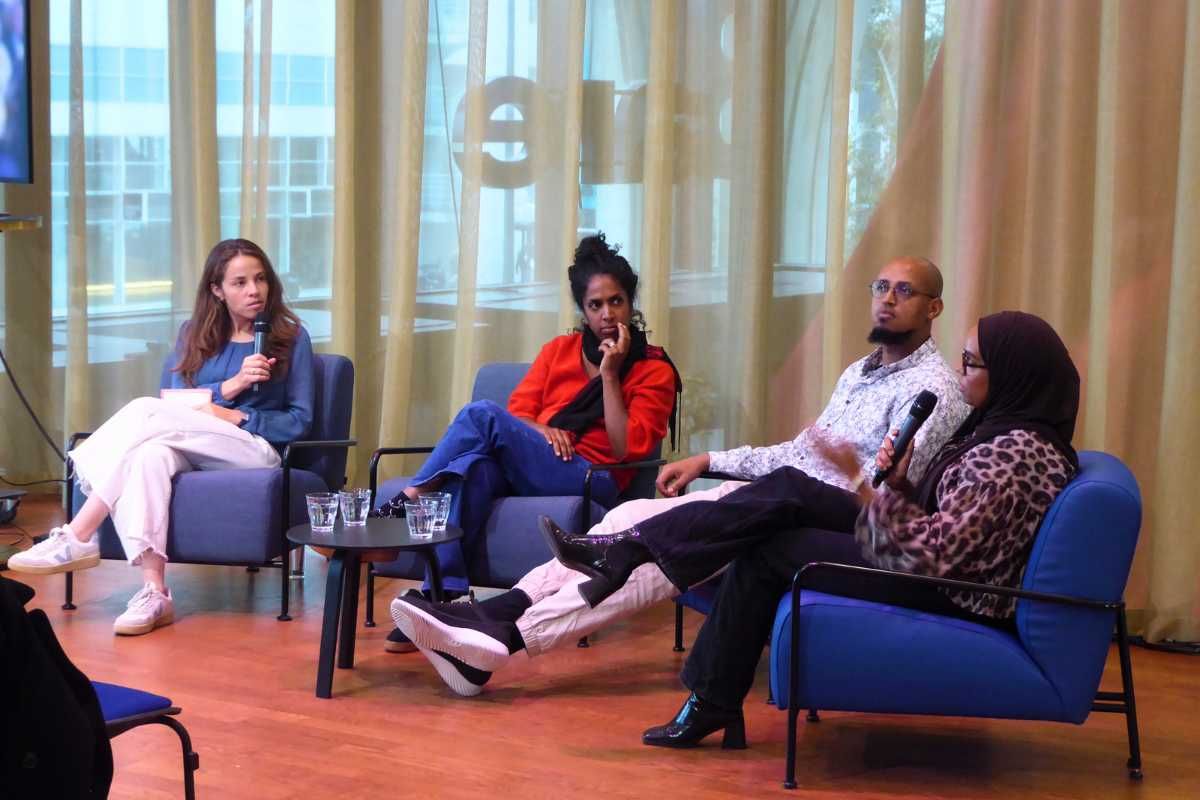
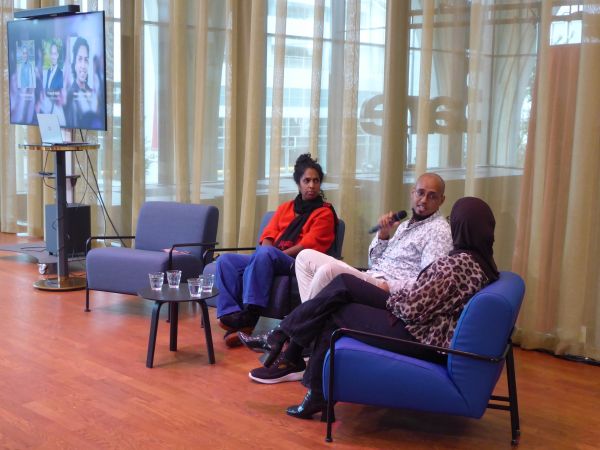
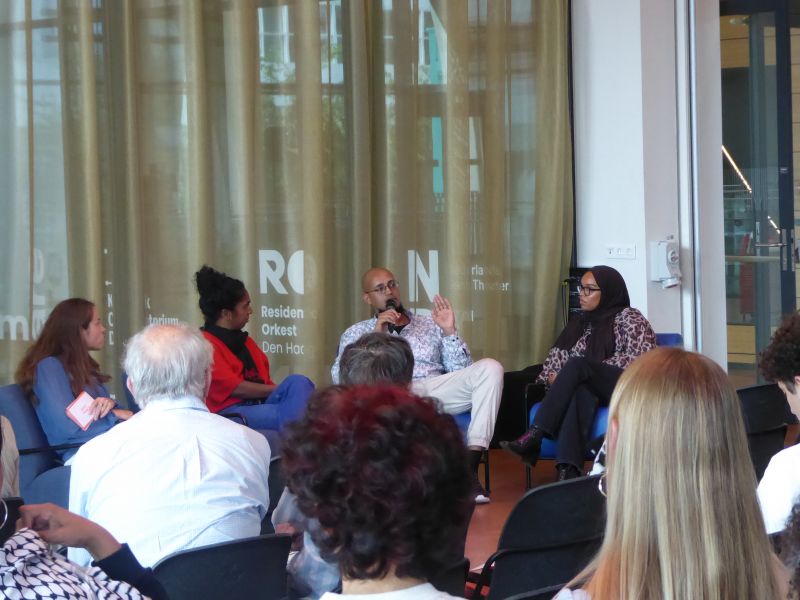
From left to right: Sacha Celine Verheij (moderator), Manon Tiessink, Yussuf Abdi en Fakiha Ahmed.
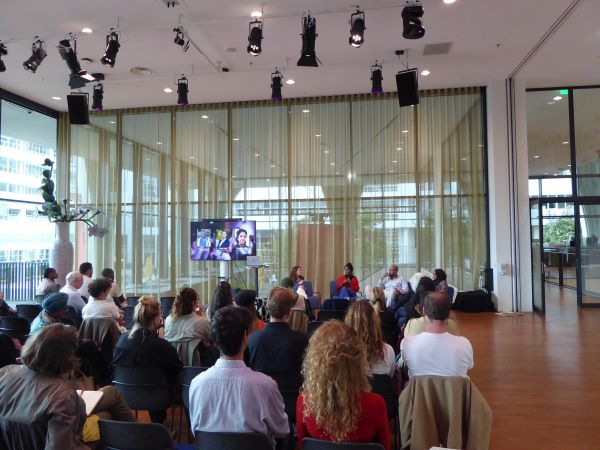
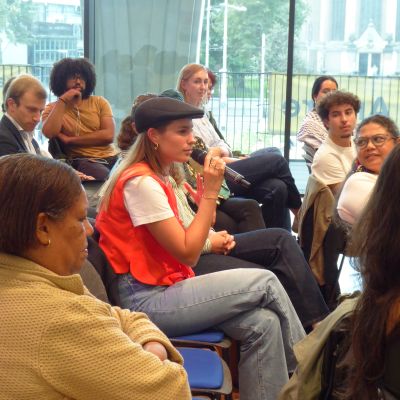
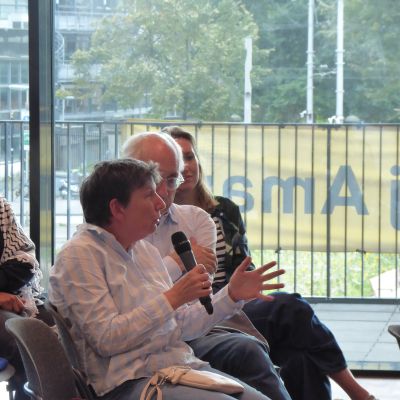
In the run-up to the elections, with institutions and freedoms under pressure, residents, activists, and changemakers gathered in The Hague for a Just Peace Dialogue: Voices from the City. The discussion did not focus on policies or party programs, but on a more urgent question: what can we, as residents, do when social cohesion is increasingly under strain?
The evening brought together three speakers who each found their own path in this work: Fakiha Ahmed (Oxfam Novib), born and raised in The Hague; Yussuf Abdi (Hijaz Community), a dialogue-focused bridge-builder; and Manon Tiessink (Coalition Schilderswijk/Stichting Jacobahof), active for many years in the Schilderswijk neighborhood. The conversation was co-organized by The Hague Humanity Hub and Oxfam Novib.
Personal Motivations
For each of the speakers, the story began close to home.
Manon shared how she was inspired by her own neighborhood: “In the Schilderswijk, I saw how people shaped their community together. Not as a project, but as a true community. That’s where I found my place.”
For Fakiha, motivation came from a painful gap: the city is globally known as the capital of peace and justice, yet that ideal is often invisible to its residents. “For me, it wasn’t the buildings that brought peace, but the neighbors who brought food when there was none at home. That has always driven me.”
Yussuf emphasized his role as a bridge-builder. He described visiting villages in traditional Islamic clothing where many people vote for the PVV. “Some people walk away, others engage in conversation. And it is precisely in those uncomfortable conversations that connection is created.”
Trust and Participation
It quickly became clear that trust was the thread running through the evening. Yussuf noted that many residents no longer feel protected by institutions: “Trust is gone. People rely on each other more than on a service desk.”
Fakiha added that ‘participation’ is often only recognized when it goes through official channels. “What happens on the schoolyard or in the sports club is invisible. Yet that is where real connection occurs.”
Manon spoke of the need for radical participation: reclaiming space for residents themselves instead of getting lost in bureaucratic systems.
The Burden of Connection
Fakiha made a sharp observation: “It is often marginalized groups who must repeatedly prove that they belong. They bear the burden of constantly connecting. That is not fair.”
Manon nodded in agreement. Sometimes, she said, it may even be beneficial to polarize, as long as communities can focus on their own story and narrative.
“The burden of connecting often falls on marginalized groups. Sometimes, we also need to relieve people from the constant pressure to ‘keep connecting.’”
The Role of Large Organizations
The discussion then shifted to what large international organizations such as Oxfam Novib can do. Fakiha stressed that their work should also be closer to home: “You cannot fight for human rights abroad if you do not protect them here in the Netherlands.”
Manon pointed to discrimination in education, internships, and healthcare, and called on large organizations to also use their resources to strengthen protection locally.
Community as a Counterforce
A recurring theme was that trust is strongest within communities themselves. Yussuf said, “We have more in common than what divides us.”
Manon illustrated this with an example from the Schilderswijk: a community restaurant where people eat together, pay what they can, and new opportunities arise. “We are simply neighbors. People come because they enjoy it. And from that encounter, something bigger grows.”
Key Takeaways
At the end of the evening, the speakers were asked what advice they would give to a resident who feels powerless:
- “Come live with us, and join in,” smiled Manon.
- “Find the bridge-builders in your community,” said Yussuf.
- “It’s okay to feel powerless. But keep going. Radical solidarity is needed,” concluded Fakiha.
The Just Peace Dialogue showed that, in times of polarization and uncertainty, the strength of community may be our most tangible form of democracy.