From local struggles to global change: the people behind Impunity Watch
Meet Impunity Watch in The Hague during Just Peace Open Day 2025. This international nonprofit has been working for over fifteen years to prioritize the voices of victims of human rights violations in processes of justice and reconciliation. We spoke with Gelena Vougianovits and Iman Ghosh about their work, their personal motivations, and what makes Impunity Watch distinctive.
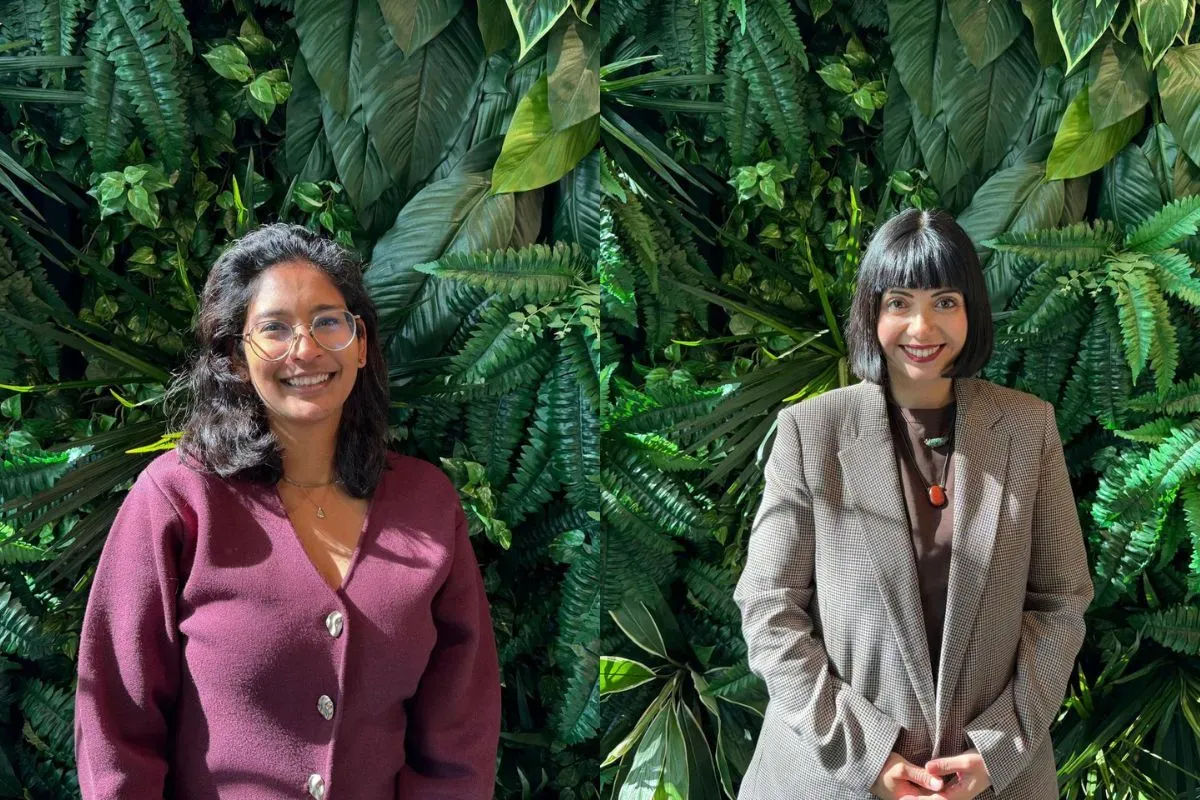
Left Iman Ghosh, right Gelena Vougianovits.
"It is about connecting local struggles with global debates, amplifying the voices of affected communities in international spaces, and challenging entrenched systems from within. Working here allows me to bridge worlds: between survivors and policymakers, between local realities and international frameworks."
Can you tell us a bit about yourself? What does it mean to you personally to be working in The Hague?
Gelena Vougianovits: My name is Gelena Vougianovits and I am a Programme Coordinator and Gender Focal Point at Impunity Watch.
Originally displaced by the war in ex-Yugoslavia and raised in Greece, I grew up navigating questions of borders, identity, conflict, and justice—an experience that continues to shape my professional and personal journey. Over the past 12+ years, I have worked across the Middle East, Africa, and Europe in humanitarian action, development, and human rights. Today, my work focuses on transitional justice, localization, decolonisation, and dismantling systems of impunity through programme coordination, monitoring, evaluation and learning, donor engagement and fundraising, and advancing gender transformative approaches in transitional justice.
For me, being based in The Hague—the international city of peace and justice—means much more than proximity to institutions. It is about connecting local struggles with global debates, amplifying the voices of affected communities in international spaces, and challenging entrenched systems from within. Working here allows me to bridge worlds: between survivors and policymakers, between local realities and international frameworks.
Iman Ghosh: My name is Anupa (Iman) Ghosh, and I’m a Communications Officer at Impunity Watch.
I grew up in Singapore, and spent seven years in Vancouver, Canada, where I studied Sociology and Gender Studies at the University of British Columbia. I’ve worked across a range of community-based non-profit organisations in both Singapore and Vancouver on issues ranging social services for First Nations youth, the cerebral palsy community, the welfare needs of elderly citizens, best practices for social work, and more. For several years, I was also a senior writer and researcher at a media site, which uses data-driven visuals to make the world’s information more accessible.
Being able to combine my love for uncovering meaningful, impactful stories with working in the field of human rights that I am deeply passionate about – and especially in the place that is home to so many critically important international justice actors – is a dream come true.
"What makes IW distinctive is its long-term, partnership-based approach: we work alongside communities and local actors to co-create strategies, amplify their voices, and connect them to international arenas where decisions are made. Through research and knowledge-brokering, coalition-building, and policy advocacy, we aim not only to respond to violations, but to change the underlying dynamics that produce them."
What is Impunity Watch and what does it do?
Gelena: Impunity Watch (IW) is an international non-profit organisation that works to ensure survivors of grave human rights violations are not only heard, but are able to shape the processes of justice and accountability that affect their lives. Our work is grounded in the belief that justice must go beyond institutions and courtrooms. It must address the root causes of impunity and help transform the systems that allow violence and exclusion to persist.
For over fifteen years, IW has been active in contexts as diverse as Guatemala, Burundi, the Democratic Republic of Congo, Syria, Iraq, Tunisia, and the Western Balkans, supporting survivors and local civil society in their struggles for truth, recognition, and redress.
What makes IW distinctive is its long-term, partnership-based approach: we work alongside communities and local actors to co-create strategies, amplify their voices, and connect them to international arenas where decisions are made. Through research and knowledge-brokering, coalition-building, and policy advocacy, we aim not only to respond to violations, but to change the underlying dynamics that produce them.
Iman: Impunity Watch is an international non-profit organisation with a strong focus on victim-centred approaches to shape justice processes towards lasting systemic change. For over fifteen years, we’ve worked with victims of human rights violations to deliver redress, transform the root causes of impunity, and promote justice and peace. We do this through three main strategies: gathering and sharing knowledge, expanding coalitions and partnerships, and mobilising joint political action.
With our roots in Guatemala, we now also work in Burundi, the Democratic Republic of Congo (DRC), Syria, Iraq, Tunisia, and the Western Balkans. Each context has its unique challenges but also opportunities to reclaim space for survivors that have often been sidelined in justice processes and their rights, and I’m grateful to play a part in helping shape our important work.
"What I enjoy most is that my role constantly challenges me to learn, adapt, and rethink power dynamics, reminding me that justice is not static, but something we must co-create with survivors and communities every day."
What does a day in the life of your job look like?
Gelena: A day in my role rarely looks the same, but it always involves a lot of connecting and coordinating across countries and teams. Much of my time is spent in close contact with colleagues in Guatemala, Burundi, DRC, Syria and Iraq —discussing programmatic activities, transitional justice priorities, and the needs of victims and survivors of human rights violations. I help to plan and coordinate activities, facilitate discussions, share knowledge, mobilise connections with external stakeholders, and contribute to fundraising efforts that sustain our work.
As Gender Coordinator at IW, I work with colleagues across programmes and with partner organisations to advance gender-transformative approaches, embedding them in our strategies and day-to-day practice. My days also include reading, reflecting, and learning because working in transitional justice and human rights requires constant adaptation and growth.
What I enjoy most is that my role constantly challenges me to learn, adapt, and rethink power dynamics, reminding me that justice is not static, but something we must co-create with survivors and communities every day.
Iman: It’s more like “what does a month look like”, because I’m always planning ahead! Being a support role, I am regularly in contact with several teams across the world. Knowing what key activities, events, or research are coming up helps me stay on top of organising and curating our strategic communications, content, campaigns, and outreach, while staying flexible to the needs and priorities that arise – at any given time, I’m working on 4-5 different things happening in a single week. This also lets me consistently brainstorm and test out different ways to stay creative and to craft messages that resonate best with different audiences and at various levels of policy and advocacy. It’s certainly a lot more than just social media and designing pretty graphics!
I also participate in our internal Gender Working Group, where we regularly meet and coordinate on integrating gender-transformative approaches across all aspects of the organisation, allowing me to engage with the substantive content of our cross-thematic work. Finally, I’m also the communications lead for the International Network of Victims and Survivors of Serious Human Rights Abuses (INOVAS), a platform which brings together victims and survivors from around the world, connecting their struggles and putting forward a unified voice; and the focal point for the Communications Task Force of the Global Initiative Against Impunity, a civil society-led initiative that seeks to address an increasing climate of impunity for core international crimes and serious human rights violations.
"In a landmark verdict in 2022, five former civil patrol members were sentenced to 30 years in prison for sexual violence and crimes against humanity."
Can you share a particular story or situation that made a profound impact on you?
Gelena: One of the stories that has left a profound impact on me is the Maya Achi Indigenous Women’s case in Guatemala, which Impunity Watch has been closely involved in. The case brought together 36 Indigenous women who had suffered some of the most brutal forms of sexual violence during Guatemala’s armed conflict in the early 1980s. For decades, these women faced stigma, fear, and countless obstacles in their search for justice. Yet, despite everything, they broke their silence in 2011 and pursued accountability through the courts.
In a landmark verdict in 2022, five former civil patrol members were sentenced to 30 years in prison for sexual violence and crimes against humanity. Earlier this year, three more paramilitaries were convicted. For me, what stands out is not only the courage of these women in speaking their truth, but also the way they transformed the process itself: insisting that their voices be heard as Indigenous women, demanding reparations that reflected their real needs, and reclaiming dignity in the face of deep-seated racism and patriarchy.
Their struggle reminds me that justice is not only about punishing perpetrators but also about recognition, transformation, and restoring the social fabric of communities. It is a story that continues to shape how I think about survivor-led justice and the importance of long-term solidarity.
"Seeing how the photo book was a powerful tool for community healing and social cohesion was humbling, but even more important was being able to see how the process and decision-making was entirely led by survivors and the families of those children and how much that meant for restoring dignity and shifting power dynamics."
Iman: In May of this year (2025), I was invited to Burundi to kick-off a new project on community-based MHPSS (Mental Health and Psychosocial Support) as a dynamic approach to dealing with past atrocities and multigenerational traumas In the Great Lakes region (Burundi and the DRC).
During this visit, not only was it the first time we got to meet some of our incredible colleagues in person, but we also had the privilege of visiting some of our partners to see the work of transitional justice in action first-hand. We joined some of our activities across provinces, such as the development of a photo book to document the stories of 40 young boys that were victims of a horrific massacre in 1997. Seeing how the photo book was a powerful tool for community healing and social cohesion was humbling, but even more important was being able to see how the process and decision-making was entirely led by survivors and the families of those children and how much that meant for restoring dignity and shifting power dynamics. During that visit, we also laid wreaths for the victims, and there was not a dry eye in that profound moment as we absorbed the gravity of the tragedy.
Some more memorable moments were also simply on the drives to and from these areas – for several hours, we discussed everything under the sun, and got to learn from the knowledge and lived experiences of our colleagues who are the experts of these issues inside and out.