World Refugee Day 2026: “Women are not waiting for permission to save lives; they just do it.”
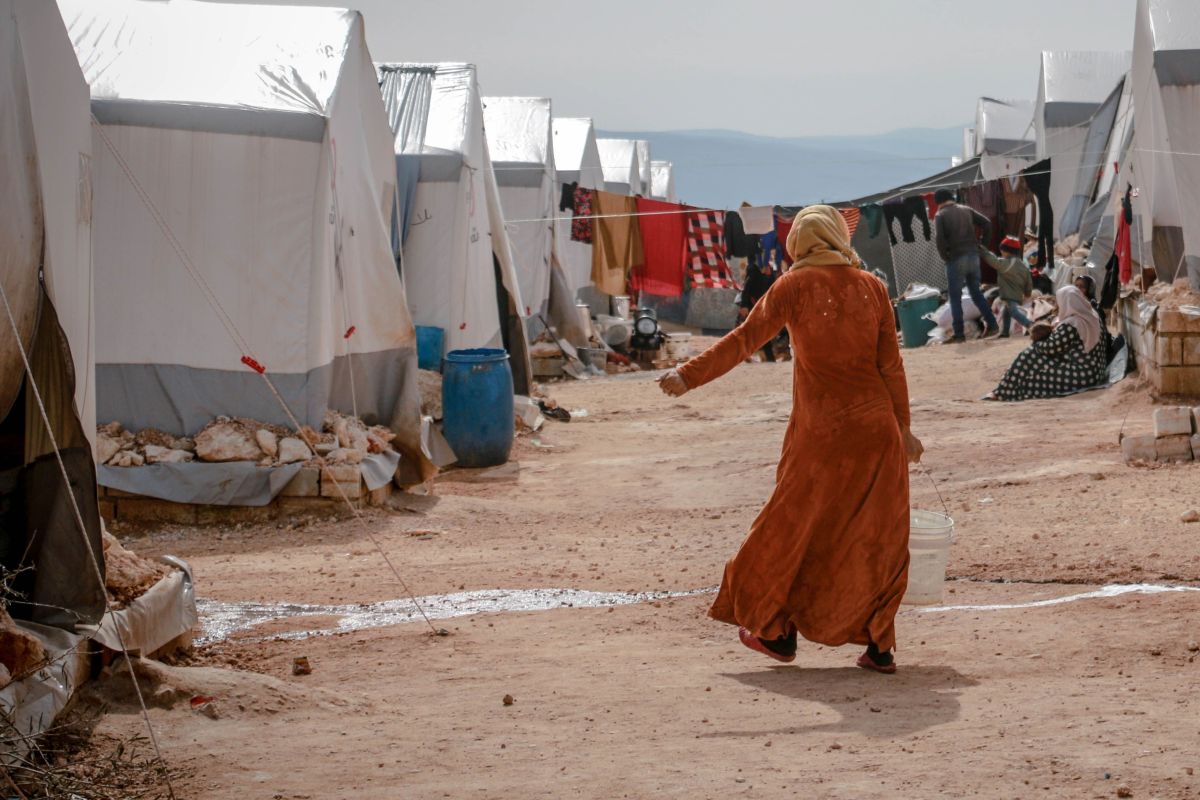
Widespread armed conflict, rapid democratic decline, and accelerating environmental crises have uprooted more than 100 million people from their homes and communities. Women and girls account for nearly half of that number, yet their specific vulnerabilities and experiences often fall through the cracks of conventional humanitarian responses.
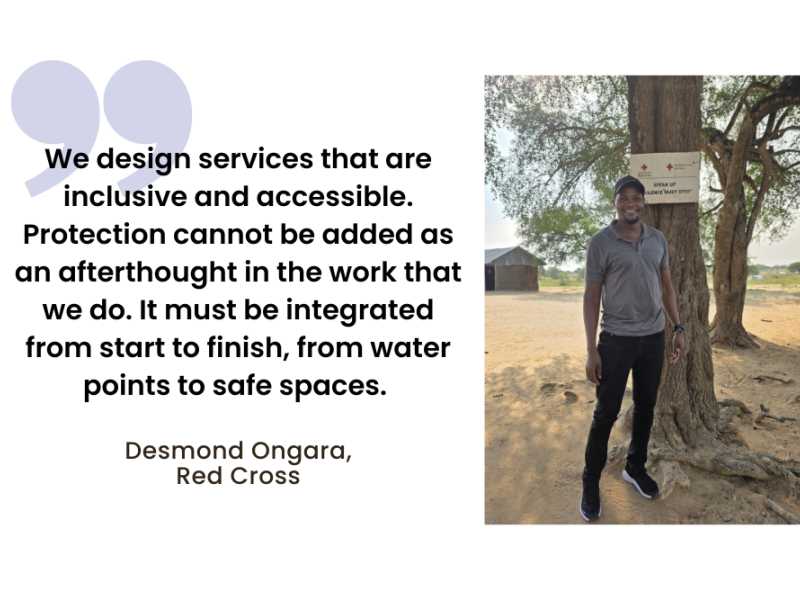
In light of World Refugee Day, we spoke with three experts working at the intersection of displacement and gender equality: Agnès Marsan and Desmond Ongara of the Netherlands Red Cross, and Mekka Abdelgabar, director of The Netherlands-Darfur Women Foundation (VOND). Working with and for displaced women worldwide, they show that women are not passive victims of prolonged conflict, but active community builders and leaders amid hardship.
The Netherlands Red Cross: “Diversity is a concept, but inclusion is an act”
As members of the world's biggest humanitarian network, Agnès and Desmond have spent years working across countless contexts marked by protracted crises and mass displacement. Their roles at the Red Cross go hand in hand: while Agnès uses disaggregated data to help align humanitarian programmes with women's needs and priorities, Desmond ensures that evidence is translated into accessible aid on the ground.
Their experience in the humanitarian sector has repeatedly shown them that women bear the brunt of forced displacement. “During displacement, women face reduced access to healthcare systems and are often exposed to gender-based violence and early marriages,” Desmond explains. “Because women often lack independent legal status and are dependent on a partner, they also face legal insecurities,” Agnès adds. “Pregnant women, single women, undocumented women, disabled women, and girls are especially vulnerable.”
Displacement may also mean a women’s safety net slips away, Agnès says. “Women's resilience mechanisms are often collective and care-oriented. When women are displaced, they are removed from these support systems. Men usually have greater access to mobility and institutions, while women have less access to both.” Displacement can also compound other existing inequalities. “Women and girls in all displacement settings experience a secondary crisis besides the main crisis,” Desmond explains. “Women often secure food and water for their families, so when these resources become scarce, it becomes even more difficult and dangerous to access them.”
“When women's resilience is strengthened, overall stability comes more quickly.”
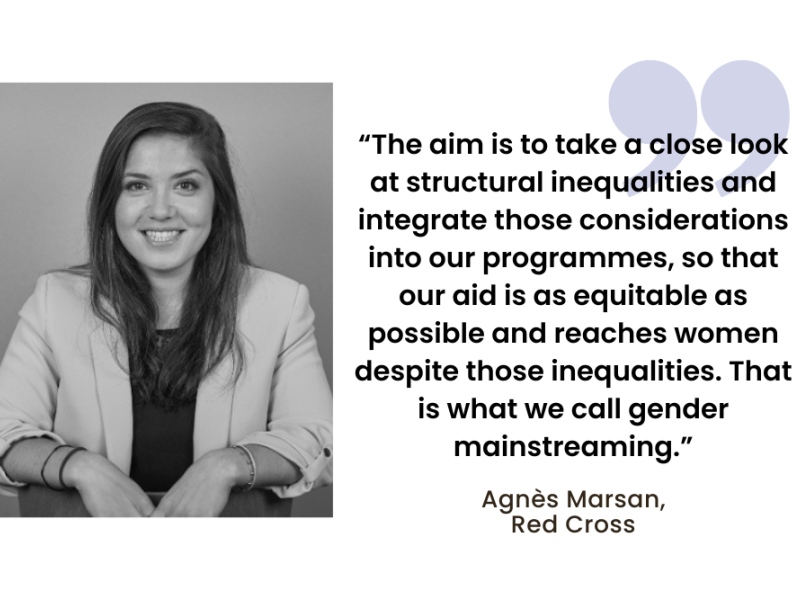
As a Gender, Protection and Inclusion (PGI) Advisor, Agnès works with the International Red Cross and Red Crescent Movement to ensure that displaced women's experiences are part and parcel of their humanitarian efforts. “The aim is to take a close look at structural inequalities and integrate those considerations into our programmes, so that our aid is as equitable as possible and reaches women despite those inequalities. That is what we call gender mainstreaming.” Once existing vulnerabilities have been identified, the team works to ensure that programmes do no harm and that there is room for feedback. “We have many steps like this that we include in every response to help structure conversations about the next steps,” Agnès says. “It is never perfect, but it is important to keep having the conversation.”
Desmond explains how he puts gender mainstreaming into practice in the field. “My working mantra is that diversity is a concept, but inclusion is an act. Gender-sensitive approaches should first recognize that people experience crises differently, based on factors like gender, social class, and disability [...] We work very closely with communities and with volunteers to identify risks and pain points. Sometimes this includes creating safe spaces or being able to link survivors of gender-based violence to people who can help them.”
As a community-focused and volunteer-based organisation, the Red Cross also seeks to centre women’s own voices in the projects meant to serve them. “Displaced women are consulted through focus group discussions, feedback mechanisms, and by volunteers,” Desmond explains. “Meaningful participation goes beyond asking for opinions; it is about sharing power and decision-making.” Proactive community engagement is, however, also subject to feedback and refinement, Agnès says. “We get better and better at adapting and listening along the way instead of just at the start […] For us, if a part of the community does not receive any aid, we have failed.”
“Within the Red Cross, we include women as decision-makers to ensure that benefits reach them directly; not just as beneficiaries, but as decision-makers.”
With the Netherlands Red Cross's headquarters in The Hague, Agnès and Desmond also see a role for the city in strengthening humanitarian support for displaced communities. “What we see all over the world is that funding and the space to discuss humanitarian issues is reducing,” Agnès says. “For the people who need this kind of inclusive help, but also in general; if we stop caring for the needs of half the population, what are we doing?” Desmond elaborates: “The unique global identity that is rooted in The Hague brings both opportunity and responsibility. The work we do depends highly on advocacy; funding opportunities come from advocacy [...] If these discussions were further entrenched in the institutions of The Hague, it would reach further.”
That responsibility becomes even more important as growing societal stigmatisation, criminalisation and exclusion of displaced communities, including women and girls, add to the weight they are already carrying. According to Agnès and Desmond, there is an urgent need to flip that narrative. “Displacement means that a regular person like you or me wakes up one day and has to run for their lives,” Desmond says. All of a sudden you have to stand in line for clothes, water, and food. It really uproots your life. You meet families who had five kids and now only have one left, women who lost everyone and are now vulnerable.” Drawing on a recent visit to a reception centre in the Dutch village of Ter Apel, Agnès adds: “People have life-threatening reasons to leave. No one leaves just for fun. Communities become stronger if we address inclusion; why did people leave and how can we communicate about this?”
“Every person deserves safety and dignity in their lives.”
When asked what gives them hope despite the challenges, Agnès immediately points to Desmond: “My hope is Desmond! As someone working at headquarters, you work with programme managers and delegates in different countries, and finding people who are real advocates and real allies, that is what gives me hope.”
Desmond also finds strength in acts of solidarity around him: “I find hope in people. I see it in volunteers supporting strangers, communities welcoming newcomers, and displaced people trying every day, even though their lives have been uprooted [...] As a humanitarian worker, you face a lot of suffering, but also a lot of courage and compassion [...] We may not be resolving the big problems, but we are doing a lot more than those who do nothing.”
From individuals, they hope to see similar humanity: “Create awareness, advocate for inclusive policies, and support the trust in humanitarian organisations. We can choose empathy over indifference. Every person deserves safety and dignity in their lives. This compassion is what the world needs, and we can choose to have it.”
“Not everyone can be a humanitarian aid worker, but everyone can support displaced people, including women and girls. Listen without judgement and step away from harmful stereotypes...”
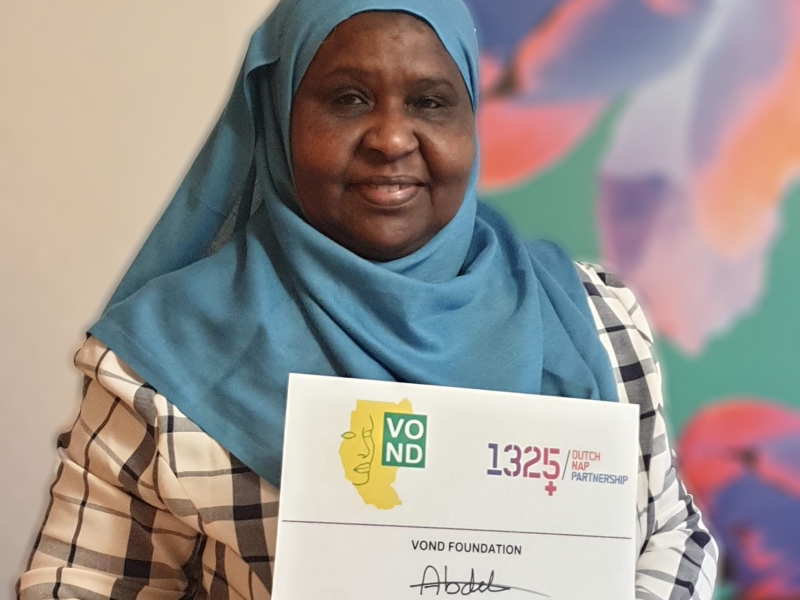
Mekka Abdelgabar and VOND: Supporting displaced women between The Hague and Darfur
While Mekka has lived in The Hague since the 1980s, her commitment to advancing the participatory rights of displaced women is closely tied to her roots in Darfur, a vast region in western Sudan that has long been affected by protracted conflict and humanitarian crises. After she temporarily returned to Sudan in 2002, a year before violence escalated in Darfur, Mekka witnessed the untiring efforts of Darfuri women to support their communities and became involved by writing up funding proposals for local aid initiatives at the Dutch embassy in Sudan's capital Khartoum. Upon her final return to the Netherlands, Mekka established VOND in 2005 to continue that work from afar.
Mekka explains that for Sudanese women, the consequences of displacement reach far beyond the loss of a physical dwelling: “Being displaced does not only mean losing your dignity, your belongings, and your hope, but it also means separation from your family. Fathers, husbands, and kids disappear or become scattered within and outside of Sudan, while mothers and sisters are left to bear the loss and keep the family intact.”
“Displaced women are forced to become strong, stronger than before. You keep your grievances to yourself, silence your emotions, and do whatever it takes to keep the family alive. It means self-denial.”
Despite the disproportionate hardships they face, Darfuri women's perspectives have long been absent from important peace processes in Sudan, says Mekka. “Under the former Islamist regime that ruled Sudan for 30 years, women were often not included in important peace negotiations, and the ones that were, were selected by the national party at the time. Sudanese diaspora women are often also accused of siding with one party or another.”
With VOND, Mekka not only works to give Sudanese women a seat at the negotiation table, but she also seeks to support local support networks set up by women themselves: “Women across Sudan, not only in Darfur, are holding community meetings even during these hard times. Community kitchens run by women operate in cities, in rural areas, in conflict zones; anywhere. These women feed thousands of people everywhere despite hardly having any funding. They are not waiting for permission to save lives; they just do it.”
When long-standing tensions between the Sudanese Armed Forces (SAF) and the paramilitary Rapid Support Forces (RSF) culminated in a brutal civil war in 2023, Sudan was pushed into the world's worst humanitarian crisis, which has since left over 4 million women and girls internally displaced. The intensification of violence across the country has also complicated Mekka's ability to support affected women: “Before the recent war, I could often go to Sudan to meet and coordinate with the women there. We formed committees, and I mediated between conflicting tribes. But after funding stopped in 2018 and the war broke out, it became impossible to go there. The RSF is from Darfur, so many Darfurians are accused of being RSF supporters. Due to my activistic work, they might also accuse me of being part of the RSF if I enter the country.”
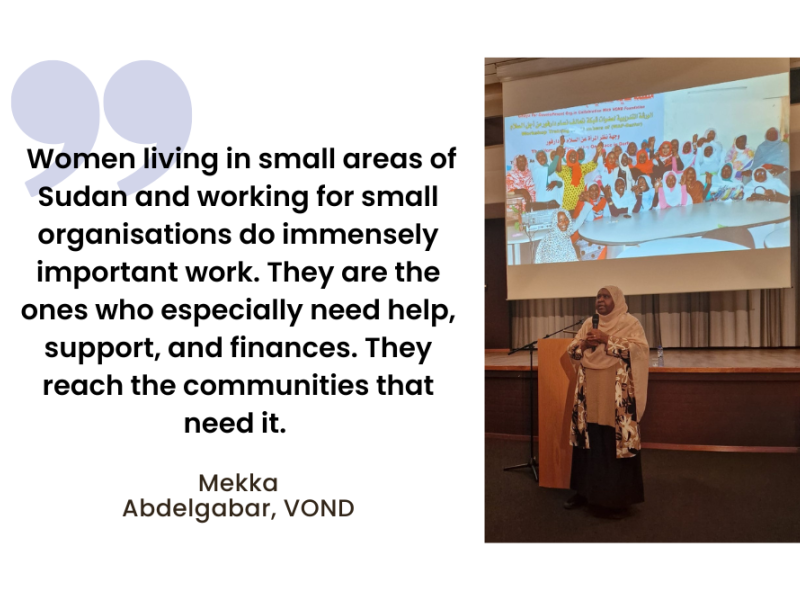
In remote areas of Sudan where humanitarian access has been especially curtailed, community-led initiatives therefore play an important gap-filling role. “While the international community cannot always reach rural areas, local communities can,” Mekka explains. “It's hard to get funding; you need to write a proposal and a post-report in English, in formal professional language. This is a major barrier [...] Women living in small areas of Sudan and working for small organisations do immensely important work. They are the ones who especially need help, support, and finances. They reach the communities that need it.”
“It's like a puzzle: the families we support will let us know that other families are even more in need, and so the community grows.”
In the Netherlands, VOND also helps Sudanese diaspora women and children with integration and community-building, for example by organising fundraisers at local community centers. “In The Hague, everyone who's involved is doing their part to support their region,” Mekka says. “We have WhatsApp groups where we send around calls for support, and together we can send funding to the groups that matter. If the government cannot fund us, we try to do it ourselves [...] It's like a puzzle: the families we support will let us know that other families are even more in need, and so the community grows.”
At the same time, Mekka still calls upon international governments to step up their efforts to end the ongoing destruction in Sudan, not only by resuming humanitarian funding, but also by cutting their own ties to the conflict. “Because other countries are supplying weapons to Sudan, the conflict has turned into a proxy war,” Mekka explains. “When the Netherlands sends weapons to the United Arab Emirates (UAE) and Saudi Arabia, the UAE can send them to Sudan to support the RSF, and Saudi Arabia can send them to Sudan to support the SAF. That complicity is fueling the war.”
According to Mekka, individuals can also call their own governments to account. “Spread awareness and support financially if possible. Any small contribution here has a big impact there. And hold your government accountable. Raise awareness of the Netherlands's economic involvement with the UAE, including through gold trade and weapon deliveries. Boycott products that fund exploitative businesses in Sudan. So many women work in the gum arabic industry but get nothing back from it.”
“We want to work together. Approach the superpowers and see what it would take for them to stop supplying these weapons.”
Rethinking displacement
The legal and political climate surrounding migration and displacement has grown increasingly hostile. From stringent border laws to brutal attacks on local reception centres; the worldwide surge in anti-immigrant rhetoric risks further stripping away the rights of refugee women and other displaced communities.
The heightened vulnerability of displaced women and girls in the context of these developments must be met with gender-sensitive responses. At the same time, depicting refugee women as victims alone obscures their tenacity and adaptability during the worst crises. Whether as mothers, sisters, caregivers, or aid workers; displaced women have consistently provided the building blocks for the recovery of communities who have been looted and uprooted by conflict.
As Desmond concludes: “Displacement is not a political issue; it is a human issue. Behind every number is a mother protecting her child, a girl dreaming of going to school, or a family hoping to be safe. We cannot turn away people at their most difficult moments. We need to meet them with compassion, not discrimination.”
Donate to the Red Cross via: Doneer.rodekruis.nl
And follow the work of the Netherlands Red Cross and VOND via: